Planning the Pacific 62 delivery from North Queensland to Bali - Part 1
Yacht Delivery Solutions takes the Dickey Boats Pacific 62 from Port Douglas to Bali. A look at fuel management, weather routing, and passage planning
Pacific 62
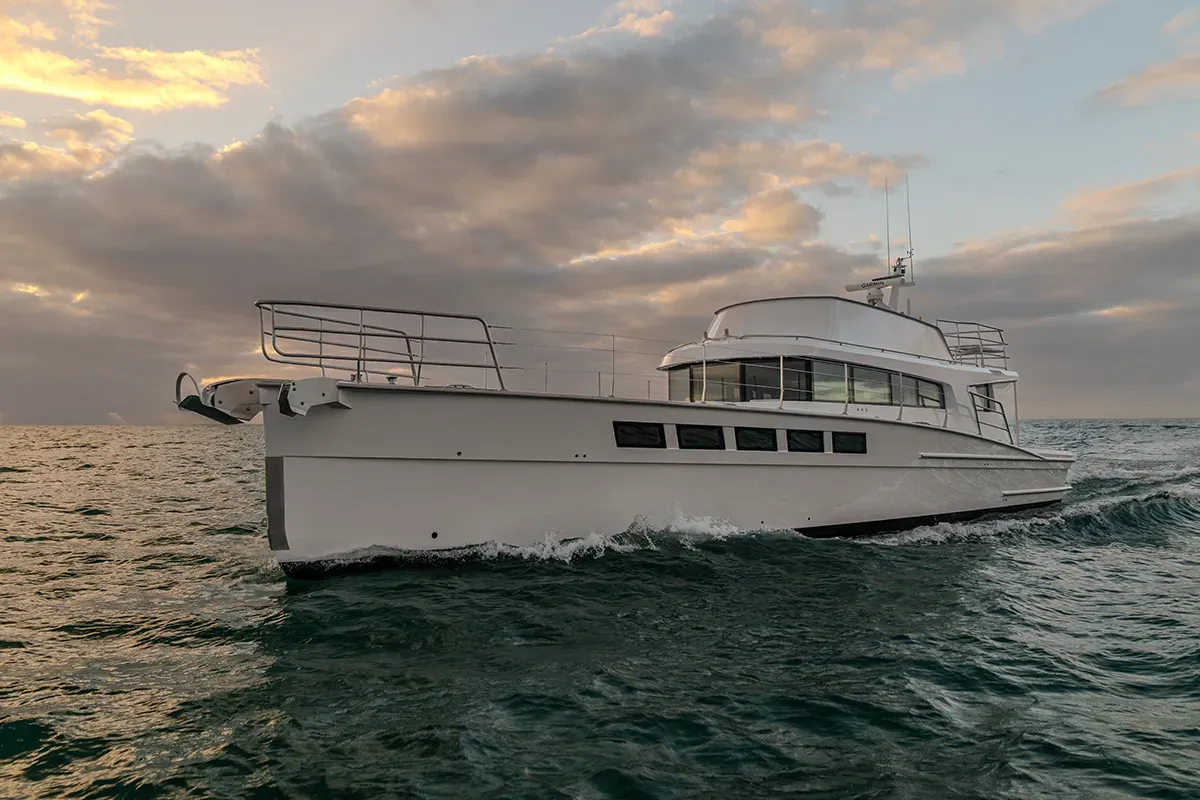
Yacht Delivery Solutions takes the Dickey Boats Pacific 62 from Port Douglas to Bali. A look at fuel management, weather routing, and passage planning
Published with the permission of Yacht Delivery Solutions, Keri Keri, New Zealand.
Earlier in the year, Yacht Delivery Solutions was engaged to deliver the Dickey Boats Pacific 62 Moonlao from Opua to Bundaberg. We were invited back a few months later to deliver the vessel from Port Douglas in North Queensland to Bali.
A delivery like this highlights the operational planning required when moving a large offshore-capable power yacht across northern Australia and into Indonesian waters. While a vessel of this size and capability could technically complete the passage in a single run, practical considerations around weather, fuel quality, and clearance procedures typically favour a staged approach.
A delivery crew from Yacht Delivery Solutions travelled to Cairns and then up to Port Douglas Marina to prepare the vessel and finalise the passage plan before departure.
Fuel Strategy and Management
Fuel planning is one of the key considerations for a passage of this length.
Although the Dickey Pacific 62 has sufficient range to make it to Bali without stopping, the decision was made to clear internationally from Darwin rather than depart Australia directly from Port Douglas. Darwin provides access to reliable, high-quality fuel and allows tanks to be topped up before entering Indonesian waters, where fuel quality can sometimes be inconsistent depending on location.
Fuel Management and Polishing on Long Deliveries
Fuel system management is one of the most critical operational considerations on a long-range power yacht delivery. Even when a vessel has sufficient range for the entire passage, the reliability of the fuel system determines whether the engines will run consistently for days or weeks at a time.
On vessels like the Dickey Boats Pacific 62, fuel is distributed across multiple tanks connected through a manifold system. This allows the delivery crew to control which tanks are supplying the engines and which are being circulated through the polishing system.
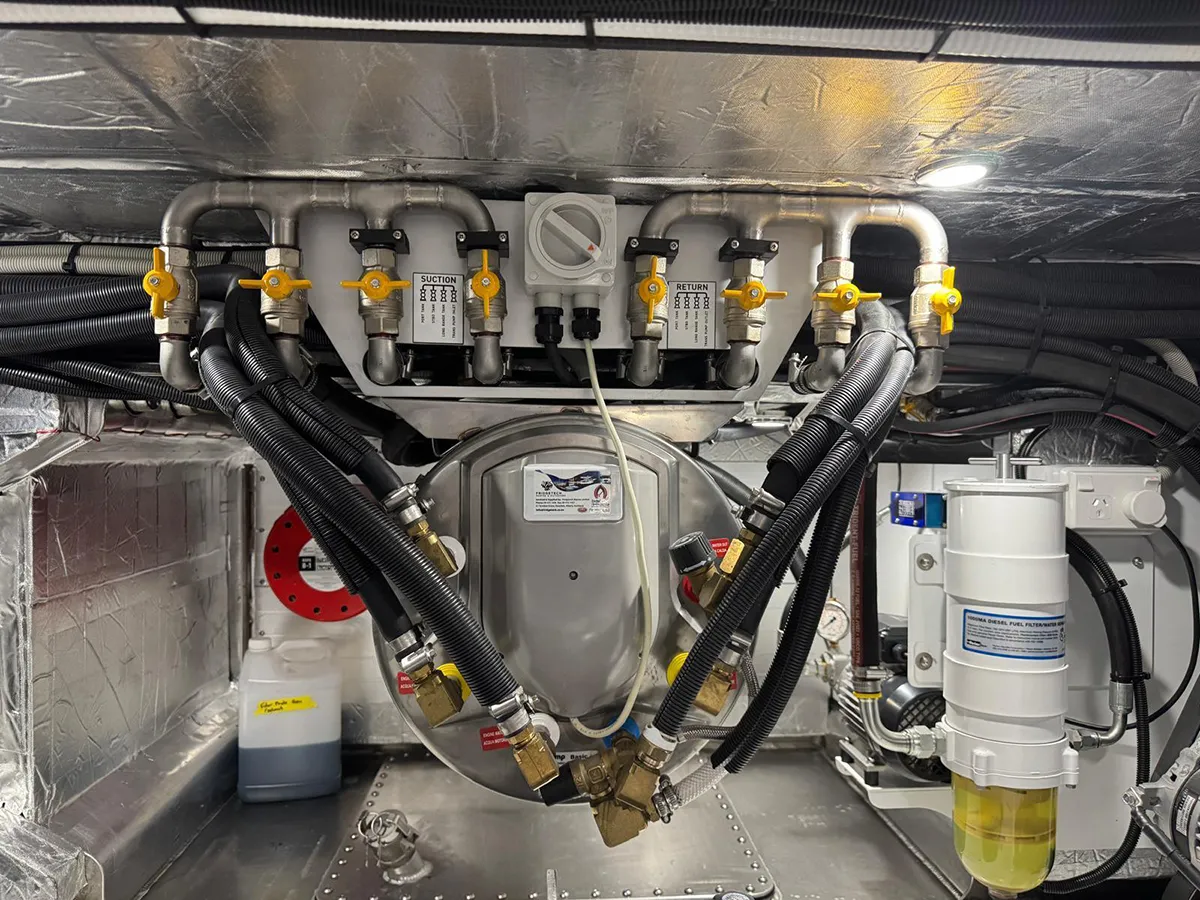
The system shown here is a dedicated fuel polishing unit connected through a fuel manifold. Each valve corresponds to a specific tank, allowing the crew to isolate tanks individually. Fuel can be drawn from one tank, passed through a series of filters and separators, and returned either to the same tank or to another. This process removes water, microbial contamination, and fine particulates that can accumulate in fuel over time.
During long passages, the polishing system is often run periodically rather than continuously. Tanks can be polished sequentially, ensuring that all fuel onboard has passed through the filtration system before being used by the engines. This significantly reduces the risk of blocked filters or engine interruptions while offshore.
The manifold also provides operational redundancy. If contamination were suspected in a particular tank, it can be isolated immediately while the engines continue to draw from another. The affected tank can then be polished or transferred without interrupting propulsion.
Fuel filters on the main engines are monitored closely throughout the passage. Differential pressure gauges and visual inspection of primary filters help identify contamination early, allowing filters to be changed before they restrict flow.
For deliveries that may involve refuelling in remote locations, the polishing system becomes even more important. Fuel can be circulated and cleaned before being used by the engines, providing an additional layer of protection against poor fuel quality.
In practical terms, systems like this turn fuel management from a passive concern into an actively managed part of the vessel's operation throughout the delivery.
Weather Planning Across Northern Australia
Weather routing across the top end of Australia requires careful monitoring of tropical systems, troughs, and trade wind patterns.
At the time of departure, a cyclone watch had been issued for the region, although the system ultimately passed through as a moderate blow rather than developing into a significant storm. Forecasts for the following week indicated more unsettled conditions further west across the Gulf of Carpentaria.
Rather than pushing north immediately into deteriorating weather, the strategy was to move gradually up the Queensland coast while waiting for a more stable weather window.
A staged coastal run like this provides flexibility. It allows a delivery crew to maintain progress while avoiding unnecessary exposure to developing weather systems before committing to the longer offshore legs.
Route Decisions Along the Coast
The Daintree River was considered as a potential overnight anchorage on the first day north from Port Douglas. However, the river entrance is well known for being shallow and changeable, particularly around low tide. With limited depth available and sand movement around the entrance banks, it is not always the most practical option for larger vessels.
On arrival, the tide was still low and the entrance conditions confirmed the usual limitations. Rather than waiting for additional water or attempting the approach, the decision was made to anchor off the nearby beach where there was good protection from the north-westerly winds.
This type of adjustment is typical when working along the North Queensland coast. There are numerous sheltered anchorages available, so there is rarely a reason to push a marginal entrance when a simpler option is nearby.
Watchkeeping and Crew Management
Crew management is another important factor on passages like this, particularly when operating with a small professional delivery crew.
During coastal stages, both crew are typically active during daylight hours while navigating reefs, fishing traffic, and coastal hazards. Once offshore, watch systems are structured to ensure continuous monitoring of navigation, traffic, and vessel systems while allowing adequate rest periods.
Maintaining alertness and managing fatigue becomes increasingly important as the passage progresses into longer offshore legs.
Safety Systems Onboard
Modern yacht deliveries incorporate several layers of safety protocols.
Personal AIS beacons are commonly carried by crew working on deck, ensuring that any person entering the water can be immediately located and tracked electronically. The vessel's own AIS system also provides situational awareness when operating near commercial shipping routes.
Routine inspections of engine spaces, fuel filters, bilge systems, and navigation equipment are conducted throughout the passage as part of standard operating practice.
Customs and Clearance Planning
Another practical aspect of the delivery involved planning where to clear out of Australia.
Clearing internationally from Darwin provides operational flexibility. Once cleared, the vessel can continue toward Indonesia without needing to manage additional border procedures along the Australian coast. It also allows the delivery crew to stop at suitable anchorages along the route if required, without additional administrative complications.
Working North Toward the Torres Strait
After departing Port Douglas, the delivery proceeded steadily up the Queensland coast, cruising comfortably around 8.5–9 knots with the vessel's gyro stabiliser maintaining a stable ride.
Cooktown River provided a convenient staging point before continuing north toward Thursday Island and the Torres Strait, where the next phase of the passage toward Darwin would begin.